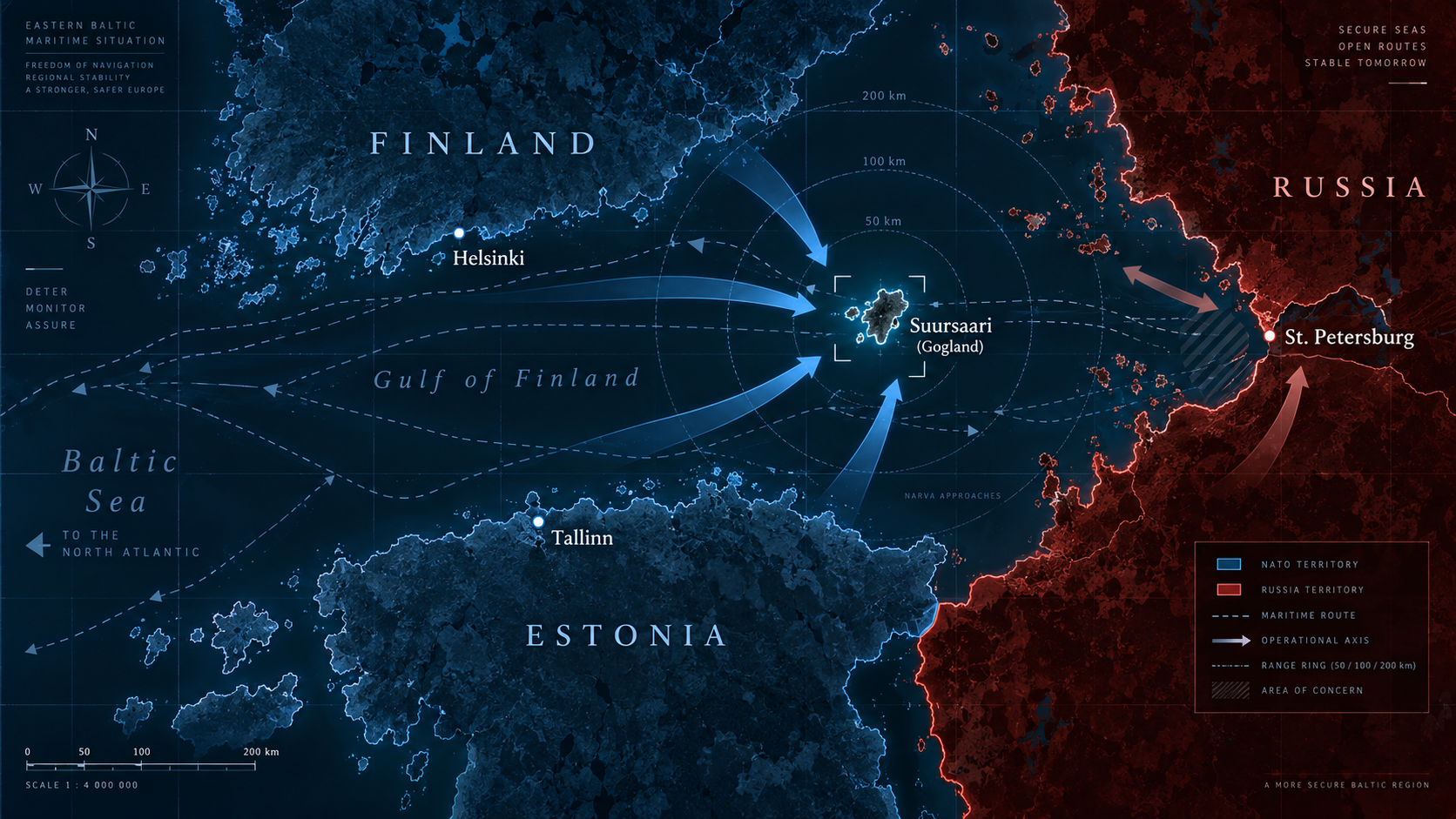
Geography is often treated as destiny in Baltic security debates—but only in one direction. Estonia’s proximity to Russia is real. So is Russia’s exposure along the Gulf of Finland, where Finnish and Estonian territory brackets the maritime approach to St. Petersburg.
A recent Institute for the Study of War scenario explored how a limited Russian incursion around Narva might seek a small territorial gain with disproportionate political effect.[1] Reversing the arrows reveals the same strategic mechanism: a local fait accompli designed to force the defender to decide whether recovering a limited position is worth a much wider war.
Figure 1
The Gulf of Finland’s reciprocal geography
01
Objectives and restraints
The imagined coalition objective is deliberately narrow: establish control over a limited, isolated Russian territorial position in the Gulf of Finland during an acute confrontation, then stop. The object would not be St. Petersburg, regime change, or a sustained advance into Russia. It would be to invert Moscow’s presumed escalation calculus.
The constraints matter more than the objective. Coalition leaders would seek to avoid civilian harm, attacks on population centers, or actions that could be interpreted as preparation for a strategic strike. The political theory would depend on making the limited nature of the action legible—even while accepting that Moscow might not believe it.
The strategic object is not the territory itself. It is the decision the loss imposes on Moscow.
02
Background and setup
The Baltic strategic map changed when Finland and Sweden joined NATO. Russia still possesses formidable regional capabilities, but the Gulf of Finland is no longer bordered by a non-aligned Finland on one side and a small NATO state on the other. Both shores now sit within the same alliance.
St. Petersburg is not merely a large city. It is Russia’s second city, an economic center, a symbol of national history, and the terminus of a narrow maritime corridor. That combination makes even a distant or symbolic pressure on its approaches politically resonant. It also makes careless scenario design especially dangerous: what one side calls limited may appear existential to the other.
Figure 2
The logic with the arrows reversed
03
Scenario assumptions
The scenario begins amid an already serious NATO–Russia confrontation, not in peacetime. Communications remain open, neither side has attacked the other’s major cities, and both governments still profess an interest in containing the crisis.
- A limited object. The position has military relevance but is not indispensable to Russia’s territorial integrity.
- A declared stop line. Coalition forces make no move toward a broader land campaign or the city itself.
- Visible restraint. Political messaging emphasizes reversibility and offers negotiations from the outset.
- Persistent ambiguity. Moscow cannot know with certainty whether the operation will remain limited.
These assumptions make the scenario analytically useful, not likely. They isolate the central question: does nuclear-backed territorial possession make every limited loss intolerable, or can the same uncertainty that complicates NATO decision-making constrain Russia as well?
04
Scenario highlights
Coalition forces establish the fact of control before Russia can reverse it at low cost. NATO capitals announce that the action is geographically bounded and will not expand if Russia refrains from counterattack. At the same time, the coalition signals that attempts to retake the position could widen the confrontation.
This is the mirror image of the Narva logic: speed creates a political fact; restraint seeks to keep that fact below the threshold of general war; escalation threats make reversal appear more dangerous than acceptance. The scenario’s tension lies in whether restraint is credible after a border has already been crossed.
Figure 3 · Decision sequence
Local fact
Public demand
Coalition test
Escalation choice
05
Immediate Russian response
Moscow’s first response would likely combine public maximalism with private uncertainty. Russian leaders would denounce the action as aggression and demand immediate withdrawal. Military forces would move to readiness, while diplomacy, information operations, and coercive signaling attempted to split the coalition.
Yet a rapid counterattack would carry risks. It could validate the coalition’s case for reinforcement, expose Russian forces to the alliance’s regional advantages, and turn a limited territorial setback into a broader conflict around Russia’s second-largest city. Delay, however, would normalize the fait accompli and raise domestic questions about state competence.
06
Strategic challenges for Moscow
The Kremlin would confront three linked problems. First, it would need to establish that the loss was intolerable without convincing NATO that a larger Russian attack was imminent. Second, it would need to preserve domestic authority while avoiding promises that left no room for diplomacy. Third, it would need to decide whether allied unity was brittle enough to justify waiting.
The proximity of St. Petersburg would sharpen each calculation. It would create public pressure for action while also raising the consequences of uncontrolled escalation. Geography would be both motive and restraint.
07
Military and operational challenges
At the operational level, Russia would face a coalition able to use both shores of the gulf for surveillance, air defense, maritime control, and reinforcement. The issue is not that the Baltic has become a “NATO lake”—a phrase that understates Russia’s capacity to contest it—but that the regional balance now imposes more complex coordination problems on Moscow.
The coalition would face its own severe difficulties. A limited position can become a liability if it cannot be sustained without continuous reinforcement. Defensive measures can resemble preparation for offensive expansion. Every attempt to improve local security could therefore undermine the political message of restraint.
08
Russian escalation options—and their limitations
Russia would retain many options: diplomatic isolation, cyber disruption, maritime pressure, military demonstrations, horizontal pressure elsewhere, or direct attempts to reverse the loss. None would be cost-free, and several could strengthen rather than fracture NATO cohesion.
Nuclear signaling would loom over the crisis but would not answer the practical question of proportionality. Threats can deter, but excessive threats can also convince an opponent that concessions invite further coercion. The scenario therefore does not show that escalation would fail. It shows why the outcome cannot be assumed in advance.
09 / Conclusion
Vulnerability is not one-directional
The lesson is not that NATO should seize Russian territory. It is that geographical exposure and escalation anxiety do not belong to one side alone. Any Russian operation designed to exploit Baltic vulnerability could induce precisely the allied posture Moscow would prefer to avoid: larger forces, firmer forward defenses, and an explicitly offensive capacity near strategically sensitive Russian territory.
The Gulf of Finland parallel clarifies the deeper deterrence problem. A limited fait accompli is attractive on paper because it appears to transfer the burden of escalation to the defender. In practice, it creates uncertainty for both sides—and uncertainty near major population centers is not stability.