In this feature
- Opening: The second map
- Background: A forward position, and an exposed one
- The crisis: An attack that has not ended
- The announcement: Temporary control, disputed purpose
- Moscow: Recover the territory, but on what terms?
- The Allied dilemma: Possession is not a settlement
- Kaliningrad: The civilian map
- The nuclear question: No predetermined threshold
- The diplomatic proposal: Two withdrawals, one agreement?
- Where the scenario branches
- Closing: What the reversed scenario tests
01
Opening: The second map
Opening map
A crisis acquires a second map
By the fourth morning, the crisis has acquired a second map.
The first shows Russian forces holding a small piece of a NATO member’s territory.
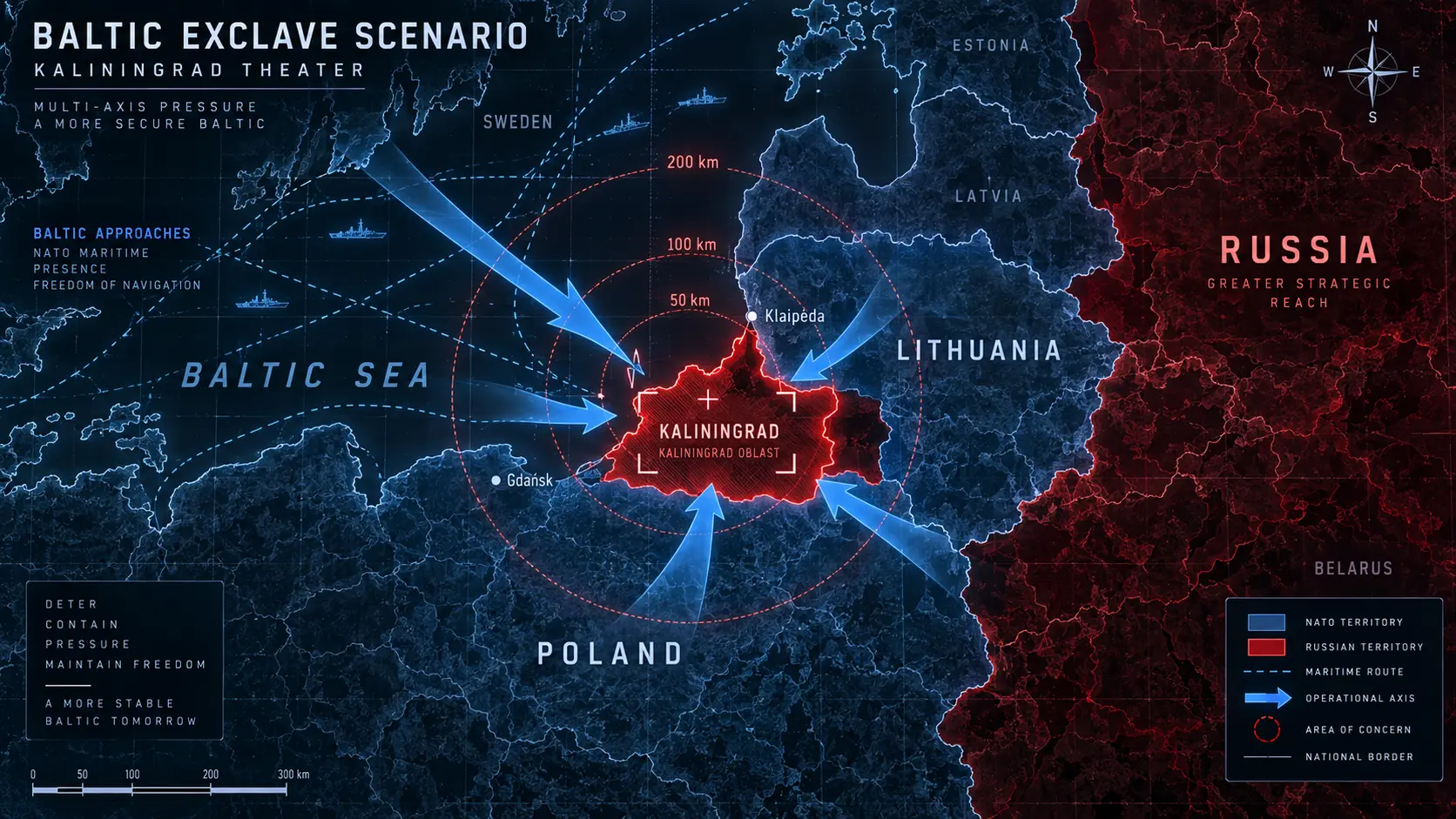
The second shows Polish and other Allied forces holding a small piece of Russia.
Kaliningrad city remains under Russian control. The regional government is still functioning. Most of the oblast has not changed hands. There has been no announcement of annexation, no claim to historical borders, and no declaration that the Russian state must be defeated.
But Russian territory is under foreign military control.
In Moscow, officials confront a question that, until now, their counterparts in NATO capitals have been debating:
What must be done to recover it—and how much larger a war could that require?
The Allied governments have a corresponding problem. They have demonstrated that the conflict can extend across the Russian border. They have not demonstrated that they can control what happens next.
Both sides describe their objectives as limited.
Neither accepts the other’s definition of the limits.
02
Background: A forward position, and an exposed one
Regional orientation
A forward position—and an exposed one
Kaliningrad is Russian sovereign territory, separated from mainland Russia and bordered on land by Poland and Lithuania. Its military significance and its geographical exposure are not competing descriptions. Both can be true.
In a 2023 analysis, CNA examined precisely that tension: Kaliningrad as a position from which Russian forces can threaten surrounding areas, but also as an isolated territory whose defence presents Russia with substantial difficulties. That analysis did not describe an undefended enclave; it emphasized continuing Russian military capabilities and the danger of nuclear escalation.[1]
An Atlantic Council scenario study likewise discusses operations against Kaliningrad in the context of a wider NATO–Russia conflict, including operations that would not require occupying the entire oblast. These are published analytical possibilities, not evidence of an approved NATO plan.[2]
The distinction matters here.
This scenario is not the conquest of Kaliningrad. It is an examination of what follows a much smaller territorial loss.
Its starting question echoes the one posed by ISW’s Narva scenario: could a geographically limited seizure create a political problem much larger than the territory involved? ISW applies that question to a hypothetical Russian attack on Estonia. Here, the defender confronting the loss of its own territory is Russia.[3]
The military circumstances are not interchangeable. Nor are the political institutions.
The parallel is the dilemma—not an assumption that the two operations would be equally easy, equally lawful, or equally dangerous.
03
The crisis: An attack that has not ended
Fictional crisis timeline
Political developments, not troop movements
Attack acknowledged
Collective assistance
Diplomacy fails
Bounded response
The scenario begins with an acknowledged Russian armed attack on Lithuania.
Russian forces hold a limited area of Lithuanian territory. Fighting continues. Lithuania has requested collective assistance. Initial diplomatic efforts have failed to produce a withdrawal.
Moscow proposes an immediate ceasefire along the existing lines of control, followed by negotiations.
Lithuania rejects a settlement that would leave its territory under Russian military control. Other Allied governments support restoring the internationally recognized border, but they disagree about how to achieve that result without expanding the conflict.
Some argue for concentrating exclusively on recovering Lithuanian territory.
Others argue that the conflict cannot be contained by geography chosen by the attacking side.
A third group asks a different question: would extending the fighting create additional leverage—or additional territory, forces and civilians that would then have to be protected?
For this scenario, assume that the Allies eventually agree to a bounded military response and that participating forces establish control over a small border sector inside Kaliningrad.
That agreement is a substantial assumption. NATO decisions require consensus, and Article 5 does not automatically prescribe a particular military campaign; each member takes the action it deems necessary to assist an attacked Ally.[4]
The territorial seizure is another substantial assumption. This account does not establish how it could be achieved, what it would cost, or whether the position could be held.
The story begins with the consequences of that assumed outcome.
04
The announcement: Temporary control, disputed purpose
Fictional scenario statements
Temporary control, disputed purpose
Allied statement
No territorial claim. Pre-crisis borders remain the objective.
Russian statement
Occupation must end without conditions.
The participating Allied governments acknowledge their presence inside Kaliningrad.
Their statement says that they recognize Russian sovereignty over the oblast, make no territorial claim, and are not seeking the surrender of Kaliningrad city or its regional administration.
They describe their action as part of the response to the continuing attack on Lithuania. They state that ending the attack and restoring the pre-crisis borders remain their objectives.
Moscow rejects this explanation.
Its statement describes the Allied presence as an occupation of Russian territory and demands an immediate withdrawal. It rejects any attempt to make that withdrawal conditional on negotiations over a separate area.
The two statements do not resolve the central issue. They expose it.
The Allies say they have created a temporary military situation in response to an ongoing attack.
Russia says they are using Russian territory as a bargaining instrument.
Inside the Allied coalition, legal advisers raise a related distinction: an action connected to stopping an armed attack is not automatically the same thing as holding territory to extract concessions.
The actual legal framework does not disappear because either side uses the word “limited.” The UN Charter prohibits the threat or use of force against a state’s territorial integrity, while recognizing individual and collective self-defence following an armed attack. Whether a particular operation falls within that right requires examining its purpose and circumstances, not merely its announced size or duration.[5]
In the scenario, those arguments continue while the military situation remains unresolved.
05
Moscow: Recover the territory, but on what terms?
Decision frame
Four responses around one unchanged map
Counterattack
Negotiation
Wider pressure
Delay
The Russian government has not lost Kaliningrad.
It has lost control of part of Kaliningrad.
That distinction leaves several possible responses.
One is to attempt to recover the occupied sector by conventional military action. But its feasibility cannot be inferred from the sector’s small size. A counterattack could succeed, fail, or become a prolonged engagement. Moscow must consider the forces already involved, the uncertainty of further Allied intervention, and the consequences of another unsuccessful operation.
A second response is negotiation. That does not necessarily mean accepting the territorial loss. Negotiations might address a ceasefire, reciprocal withdrawal, monitoring, or the order in which forces leave the two occupied areas.
But negotiations introduce a political difficulty. The Russian government has demanded the unconditional restoration of its own territory while proposing a ceasefire that would initially leave Russian forces on Lithuanian territory.
It must now explain how those positions fit together.
A third response is to apply pressure elsewhere in the conflict. That could increase the costs borne by the Allies. It could also enlarge the war without recovering the lost sector.
A fourth response is to wait: contain the situation, reinforce political demands, and see whether disagreement inside NATO forces the participating countries to withdraw.
But waiting has costs as well. The occupation persists, local uncertainty deepens, and the government must repeatedly explain why the border has not been restored.
None of these choices makes Moscow powerless.
None makes the initial territorial loss politically inconsequential.
The question is no longer simply whether Russia can threaten escalation. It is whether escalation, negotiation, or delay would produce the outcome its government seeks.
06
The Allied dilemma: Possession is not a settlement
Political distinction
Possession is not a settlement
For the participating Allied governments, the initial military result creates its own obligations and constraints.
Their stated purpose is to restore the situation before the Russian attack. Yet their forces now hold Russian territory as well.
Some ministers argue that this changes the negotiations: a ceasefire that freezes only Russia’s gains is no longer the sole arrangement on the table.
Others question whether the additional occupation makes agreement harder. Moscow may now insist on resolving Kaliningrad before discussing Lithuania. What was meant to connect the two problems could instead produce a dispute about which one must be addressed first.
A third concern is military.
The original task was to defend Lithuania and restore its territory. The coalition now also has forces inside Kaliningrad whose protection could generate further demands. Every additional measure justified as necessary to protect them could make the operation less limited than originally agreed.
The governments confront three questions.
- Can they maintain the position?
- Can they maintain agreement about its purpose?
- And can they identify circumstances in which they would leave?
These questions are related, but they are not identical.
A position could remain militarily sustainable after its political purpose has disappeared. Conversely, a government could remain politically committed to holding it after the military costs have changed substantially.
“Are we holding this position because it is helping to end the attack—or because withdrawing now would be difficult to explain?”
Another responds:
“Would leaving without an agreement help end the attack—or merely remove one of the reasons to negotiate?”
The scenario does not settle that disagreement by assigning one delegation greater resolve or better judgment.
The disagreement is part of the strategic problem.
07
Kaliningrad: The civilian map
Fictional civilian scenes
The map beyond territorial control
Home
Clinic
School
Family contact
For civilians in the affected area, “limited” describes the boundary of the operation, not the extent of its consequences.
A family cannot reach a relative across the new line of control.
A clinic is trying to confirm which deliveries will arrive.
Local officials are receiving contradictory instructions and reports. Residents do not know whether the fighting is over, whether it will resume, or whether leaving will separate them from their homes indefinitely.
Reports of military and civilian casualties are incomplete. Neither government’s initial account can yet be independently reconciled with the other’s.
The fictional Allied statement promises humanitarian access and continued civilian services.
Those promises are not merely public messaging. Where foreign forces establish the effective control that constitutes occupation, international humanitarian law imposes responsibilities toward the population. The ICRC identifies obligations including humane treatment, provision for civilian needs, respect for property, functioning medical services, and humanitarian relief.[6]
In this scenario, meeting those responsibilities becomes an immediate practical issue.
The presence is described as temporary. Nobody can tell residents how temporary.
People on the Lithuanian side of the crisis face corresponding uncertainties. A territorial exchange discussed in diplomatic language would not, by itself, repair homes, reunite families, account for missing people, or resolve the consequences of casualties.
The map used in negotiations shows areas of control.
It does not show the whole cost of establishing them.
08
The nuclear question: No predetermined threshold
Diplomatic channels
No predetermined threshold
Moscow
Warsaw
Vilnius
Brussels
Russia issues a statement referring to its nuclear deterrent.
The Allied governments cannot know from that statement alone whether it is intended primarily to influence negotiations, signal preparations, or communicate a threshold that Russian leaders believe is approaching.
The published Russian doctrine adopted in November 2024 allowed for possible nuclear use in response to conventional aggression creating a critical threat to the sovereignty or territorial integrity of Russia or Belarus. Its wording did not make every territorial incursion an automatic nuclear trigger. Neither did it provide an assurance that a small incursion would remain below the threshold.[7]
In the fictional crisis, both sides seek clarification through diplomatic and military channels.
The Allied governments emphasize the limited geographical extent of their action and their stated willingness to restore the border.
Russian officials question whether that limitation is durable. They ask whether the existing presence is a temporary position or the beginning of a larger campaign.
The Allied governments, in turn, question whether accepting Russia’s demand would bring a reciprocal withdrawal or leave the initial attack unresolved.
Communication reduces some uncertainty. It does not create agreement.
The scenario provides no basis for declaring that Russia’s nuclear references are a bluff. It also provides no basis for treating nuclear use as inevitable.
What it does demonstrate is the weakness of equating a small territorial objective with a reliably small escalation risk.
The occupied sector has not grown.
The possible consequences under discussion have.
09
The diplomatic proposal: Two withdrawals, one agreement?
Fictional draft framework
Two withdrawals, one agreement?
Fictional — draft
An intermediary circulates a proposal.
It calls for a cessation of hostilities, restoration of the internationally recognized borders in both affected areas, arrangements for verifying withdrawal, humanitarian access, and measures to address incidents during implementation.
The territorial principle is straightforward.
The implementation is not.
Russia demands that Allied forces leave Kaliningrad first.
Lithuania rejects a sequence that would remove the Allied presence while leaving Russian forces on Lithuanian soil.
The participating Allied governments propose a coordinated process. Russia questions who would verify it and what would happen if either side claimed that the other had not complied.
Even the language is contested.
Is the agreement a reciprocal withdrawal, or would that formulation obscure who initiated the crisis?
Does accepting monitoring imply doubts about sovereignty?
Can either side describe the outcome as a restoration of security without claiming that its initial use of force succeeded?
The negotiators are not deciding who owns the territories. The internationally recognized borders have not changed.
They are trying to move from military possession back to those borders under conditions both sides believe the other will observe.
In the fictional negotiations, the hardest disagreement concerns what happens between signature and completion.
Neither side wants to be the one that has already withdrawn when the other stops.
10
Where the scenario branches
Scenario junction
Three continuations; no probabilities assigned
Negotiated restoration
Conventional struggle
Wider war
Branch A
A negotiated restoration
An agreement is reached.
Russian forces leave the occupied Lithuanian area. Allied forces leave the occupied sector of Kaliningrad. Monitoring arrangements help manage disputes during the withdrawals.
The borders are restored.
Both governments claim that their actions prevented a worse outcome. Those claims remain contested.
The result does not establish that the Allied incursion was indispensable to securing the agreement. Nor does it establish that the same agreement would have emerged without it. The scenario has no controlled comparison.
Its observable outcome is narrower: the confrontation ends without a lasting territorial change, after both sides have incurred costs and accepted a negotiated process.
Branch B
A conventional struggle without a settlement
The negotiations fail to produce a withdrawal agreement.
Russia attempts to recover the sector through conventional action. The fighting continues. The Allied governments face renewed decisions about maintaining their presence, changing its scope, or leaving under pressure.
The originally limited action becomes an enduring commitment.
The narrative no longer centres on the moment territory changed hands. It centres on casualties, replacement of forces, civilian protection, coalition agreement, and the absence of an accepted way to end the confrontation.
In this branch, the territorial seizure has created another front without resolving the first.
Branch C
A wider war
One side interprets the other’s preparations as evidence that the announced limits will not hold.
Additional military action follows. Further measures are justified as responses to that action. The conflict extends beyond the original areas.
The governments still describe their choices as necessary and bounded.
Taken together, those choices produce a war larger than either publicly claimed to seek.
This branch does not require an initial decision to fight without limits. It develops through successive decisions made under uncertainty.
At that point, the Kaliningrad fait accompli is no longer a contained episode. It is one event in the history of a broader conflict.
11
Closing: What the reversed scenario tests
Closing map
Internationally recognized borders remain
The scenario began with an assumed military event: Allied forces obtained control over a small part of Kaliningrad during an ongoing conflict initiated by a Russian attack on Lithuania.
It did not demonstrate that such an operation would be feasible.
It did not establish that its political benefits would exceed its costs.
It did not establish that nuclear escalation could be excluded.
What it examined was the set of decisions that would follow.
Russia would have choices beyond either immediate capitulation or unlimited escalation. Those choices would nevertheless involve costs, uncertainty, and competing objectives.
The Allies would have achieved something more limited than a settlement. They would possess territory while remaining responsible for explaining why they held it, protecting the people under their control, and deciding how to leave.
That is the central distinction between a territorial fait accompli and a political outcome.
A military action can establish a new fact.
It cannot establish, by itself, what the other side will accept.
The analytical parallel with Narva is therefore not that Russia and NATO are interchangeable—or that either could execute a limited incursion safely.
It is that both can be confronted with a territorial loss whose significance exceeds its size.
Reversing the map does not remove the escalation dilemma.
It shows that the dilemma can arise on either side of a border.
The Other Direction
The Kaliningrad Fait Accompli
An openly fictional strategic scenario. No real operation, official endorsement, or forecast is represented.