The military geography of northeastern Europe is usually viewed from one direction. Estonia, Latvia and Lithuania are small. Finland has a 1,340-kilometre border with Russia. St Petersburg, Pskov, Karelia and Kaliningrad sit immediately behind NATO’s northeastern frontier. Maps illustrating a potential Russian attack consequently make the Baltic states in particular look alarmingly shallow: there is very little territory between the Russian border and their capitals, ports and military infrastructure.
But geography does not change when the arrows are reversed.
Since Finland joined NATO, the Alliance’s frontier has extended along a vast portion of northwestern Russia. At the same time, Finland and the Baltic states have been acquiring precision artillery, rocket systems, strike drones, coastal missiles and air-launched weapons. Ukraine has demonstrated a second model based on comparatively inexpensive long-range drones and domestically produced cruise missiles. Behind both stands the much larger European NATO arsenal.
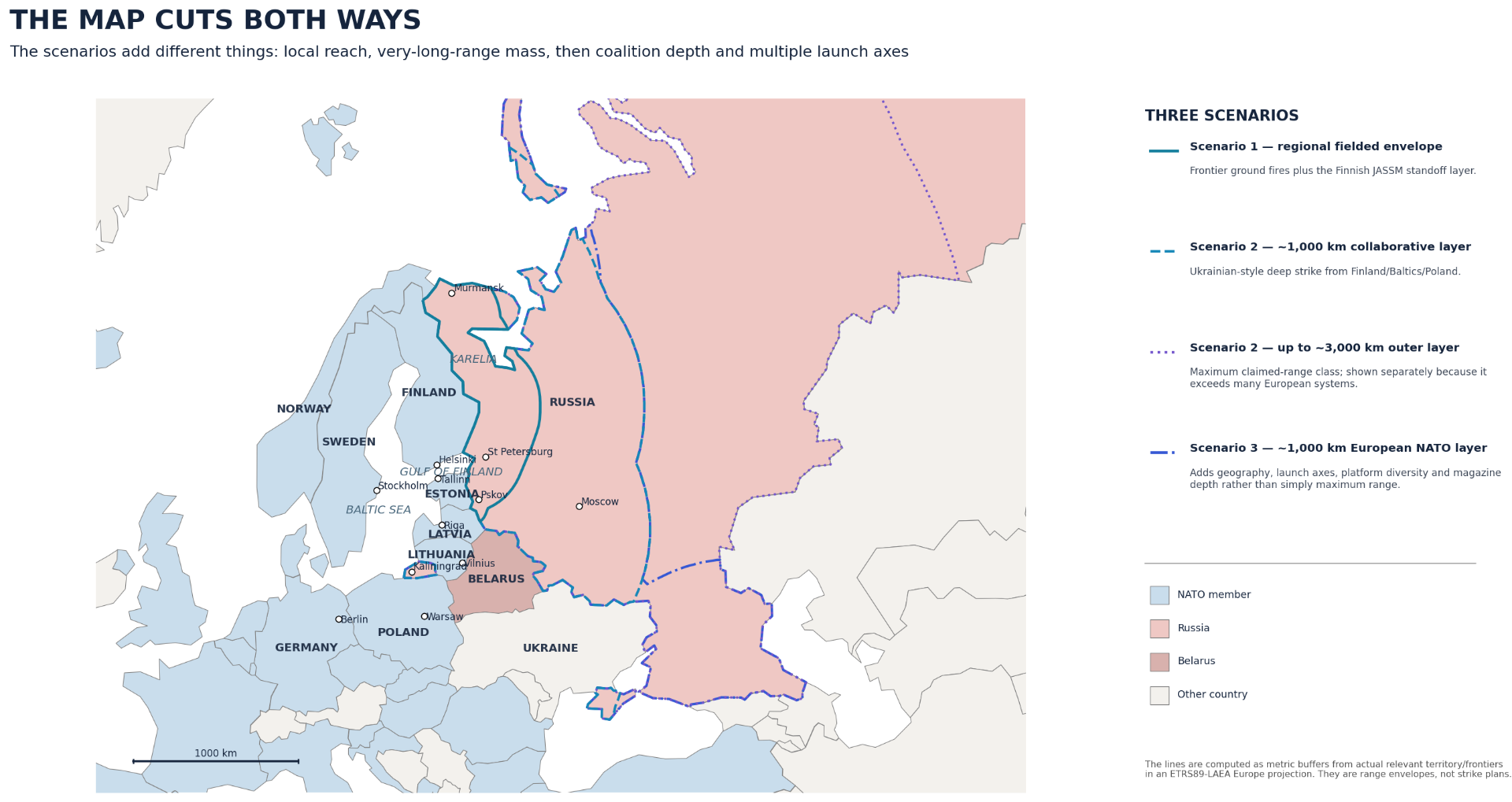
The resulting question is rarely illustrated as vividly as hypothetical Russian incursions into NATO: how much of the military system supporting a Russian war in the Baltic region could itself be exposed to conventional attack?
The answer depends enormously on which forces are assumed to participate. It is useful therefore to think in three layers.
Figure 1
The map cuts both ways
 Illustrative / not operational
01
Layer One: Finland and the Baltic states today
The first scenario requires no hypothetical Ukrainian missiles and no mass deployment of British, French or German forces. It begins with capabilities already present in the Nordic-Baltic region.
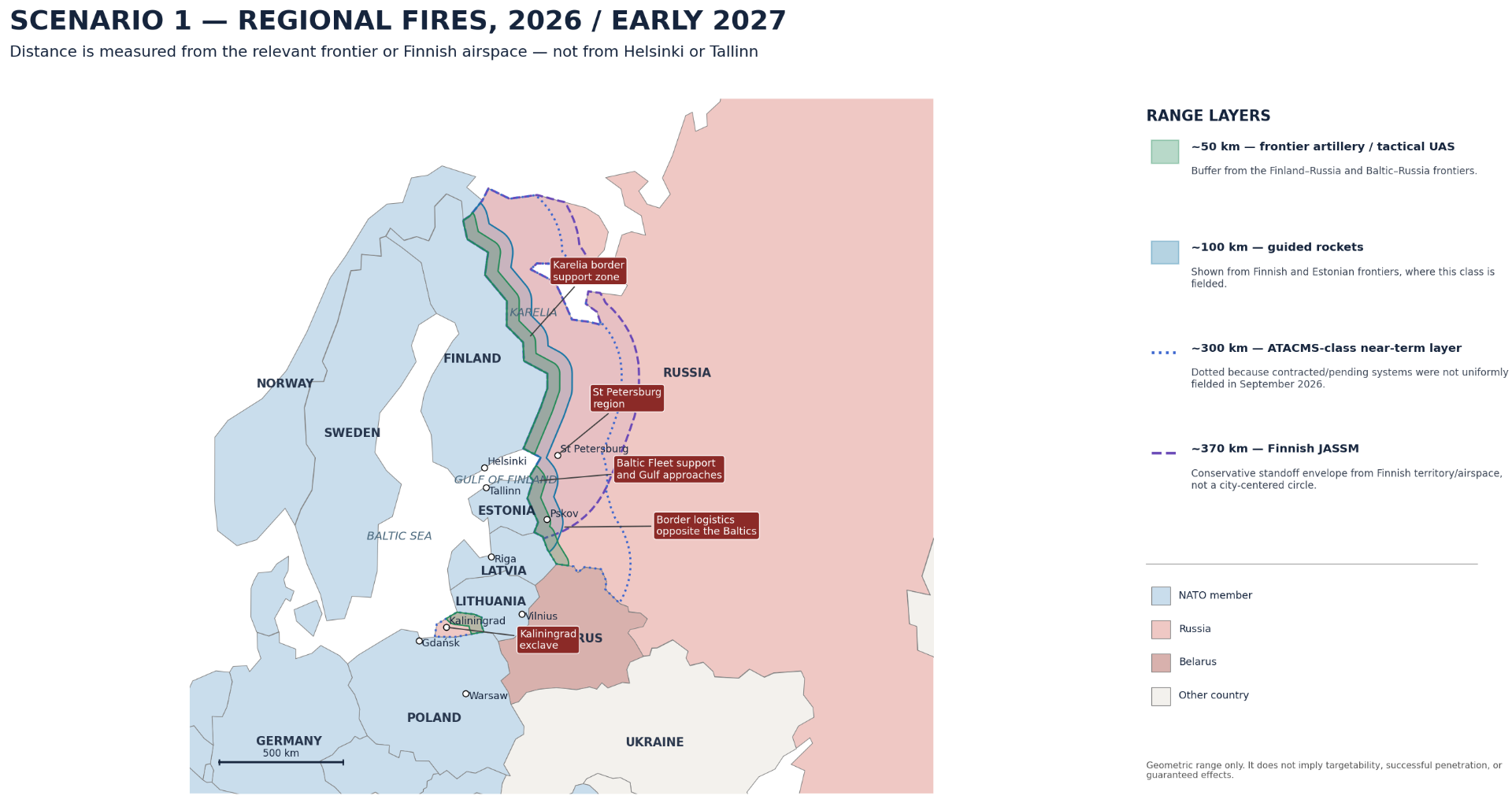
Finland possesses one of Europe’s largest artillery establishments and operates both K9 self-propelled howitzers and M270 heavy multiple-launch rocket systems. Finnish M270 units have fired guided GMLRS ammunition at ranges exceeding 80 kilometres.[2] Finland also already possesses an air-launched stand-off strike capability: JASSM was integrated into its F/A-18 Hornet fleet in 2018, well before the arrival of Finland’s F-35s.[1]
Estonia received its first six HIMARS launchers in April 2025.[3] Its longer-range missile inventory is still developing—the distinction between owning a launcher and having every compatible missile in quantity matters—but Estonia has nevertheless crossed from conventional tube artillery into precision rocket artillery. Lithuania already fields PzH 2000 self-propelled artillery and is acquiring HIMARS. Latvia operates M109 artillery and has its own HIMARS programme, although its launchers and ATACMS are principally a 2027–29 capability rather than something that should be retroactively placed on a 2026 battlefield.
Add reconnaissance and attack drones, coastal-defence missiles and increasingly integrated allied surveillance, and the first Russian problem emerges. This is not about threatening Moscow. It is about denying the immediate Russian rear the assumption of sanctuary.
Kaliningrad is the clearest case. Any Russian force fighting Poland or Lithuania from the exclave would depend on concentrations of troops, ammunition, fuel, repair capacity, air defence, communications and naval support distributed across a territory of roughly 15,000 square kilometres. In a conventional conflict, those functions would have to operate under the possibility of NATO fires.
Farther north, Russian forces operating near Estonia and Latvia would depend on military logistics, road and rail movement, ammunition and fuel distribution, repair capacity, reconnaissance and air defence in the Pskov and wider northwestern military rear. Against Finland, a comparable problem appears in Karelia: formations approaching the Finnish border would need places to assemble, transfer ammunition, repair damaged equipment and position air defence. Finland’s existing JASSM capability means the potential conventional strike problem is not restricted to the immediate land battle.
Russia has strategic depth. Russian forces fighting a war on the Finnish and Baltic frontiers do not necessarily possess the same degree of operational sanctuary.
Figure 2
Scenario 1 — Regional fires present in 2026 / early 2027
 Illustrative / not operational
What might actually be exposed?
In Kaliningrad, the relevant object is the military system sustaining the exclave: forces in assembly and reserve areas; ammunition, fuel and maintenance networks; radar and air-defence elements; military communications; and infrastructure supporting Russian naval operations in the southern Baltic. On the Estonian and Latvian axes, the exposed functions are the military rear immediately beyond the frontier. On the Finnish axis, they include military activity in Karelia and, at greater stand-off ranges, military functions in the wider St Petersburg region.
A range envelope is not a hit list. Russia possesses extensive air defence, electronic warfare, deception and dispersal capabilities. The analytical point is that Russia could not rationally plan a major conventional war on this frontier on the assumption that everything east of the international border was untouchable.
02
Layer Two: Add Ukraine’s strike-industrial model
Now make one additional assumption. A serious confrontation develops over weeks or months rather than appearing without warning. Ukraine and the Nordic-Baltic states decide to extend their existing defence-industrial collaboration into an emergency programme for long-range strike.
This is much less fanciful in September 2026 than it would have sounded two years ago. Ukraine and Lithuania signed a Drone Deal in May 2026 that explicitly provides for technology transfer and joint manufacturing and envisages the localization in Lithuania of long-range strike, naval, interceptor and bomber drones “in the shortest possible timeframe.”[4] Estonia signed its own Drone Deal with Ukraine in July.[5] Finland and Ukraine signed additional defence-industry cooperation documents in August,[6] while the Ukraine–Nordic-Baltic declaration commits the region to expanded joint production of drones, electronic warfare, air defence and other critical technologies.[7]
So in an escalating crisis, Ukraine would not arrive in the region looking for partners, contracts and industrial relationships from scratch. Much of that architecture already exists. It would still take political authorization, allocation of scarce production, crews, maintenance, communications and integration. But the assumption that Ukraine could rapidly help Baltic, Finnish and Polish partners stand up or expand Ukrainian-designed unmanned capabilities is now considerably more defensible than assuming the cooperation would have to begin at zero.
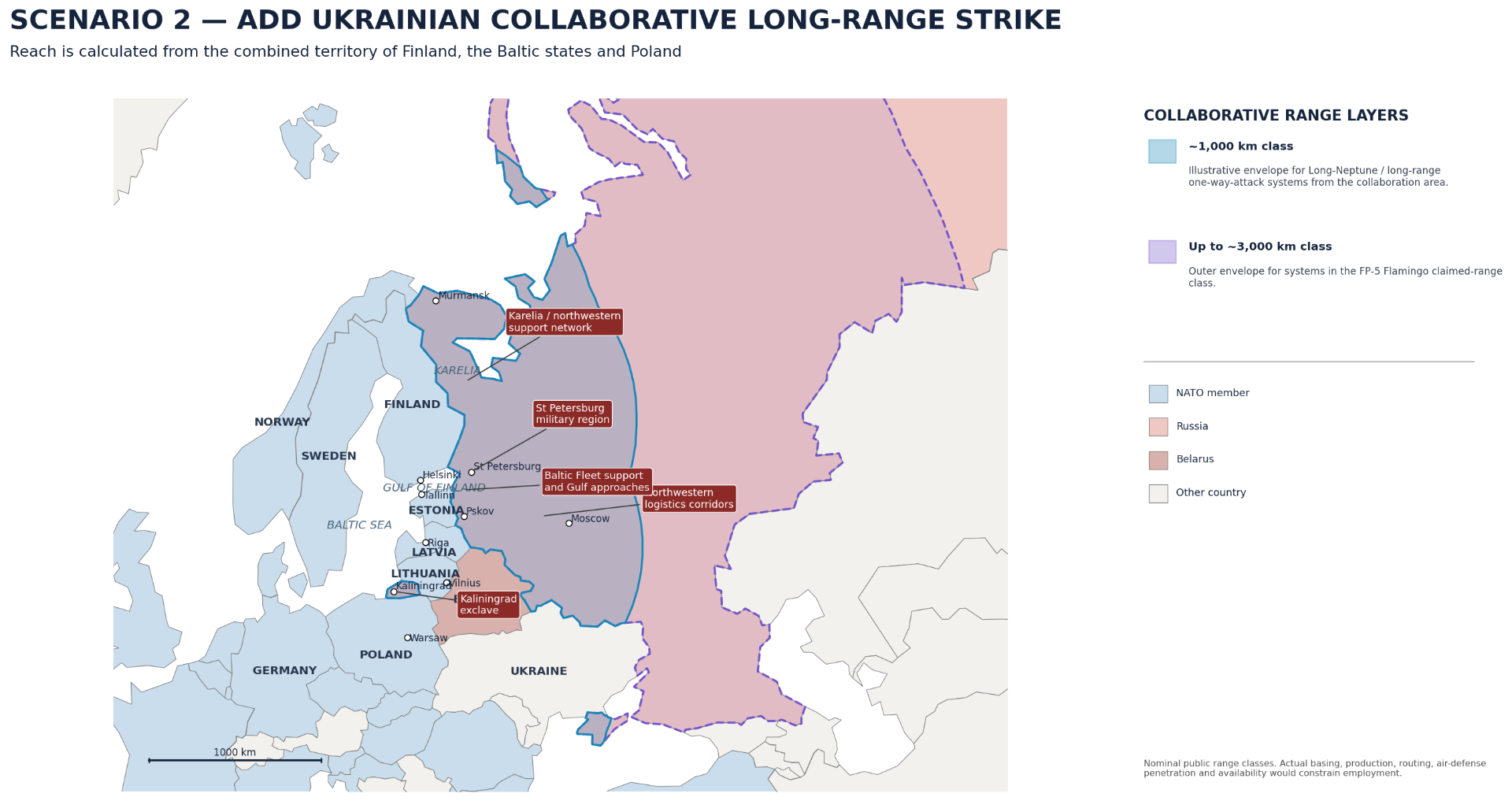
Ukraine’s publicly described arsenal includes long-range one-way attack drones exceeding 1,000 kilometres, Long Neptune at around the 1,000-kilometre class, and the FP-5 Flamingo with a claimed range approaching 3,000 kilometres. These figures are public claims rather than guarantees of wartime penetration or accuracy. The effect would nevertheless be qualitatively different from simply adding another HIMARS battery.
With Ukrainian-style systems operating in collaboration with Finland, Poland and the Baltic states, Russia would have to consider the protection of larger logistics and repair complexes serving the northwestern theatre; military aviation and air-defence infrastructure across western Russia; deeper ammunition storage and redistribution; command and communications functions; naval-support infrastructure associated with the Baltic theatre; and the transport network linking those systems to forces fighting along the NATO frontier.
The St Petersburg region is analytically important here. St Petersburg is a vast civilian metropolis and is not presented here as a target. But the surrounding region is also a major military and logistical area at the eastern end of the Gulf of Finland. Long-range conventional weapons in Finland and the Baltic region would force Russian planners to separate the protection of military functions there from the protection of the city itself.
Figure 3
Scenario 2 — Ukrainian collaborative long-range strike
 Illustrative / not operational
Mass may matter as much as maximum range
Ukraine’s most consequential contribution may not be the outer edge of the range envelope. It may be the economics of production. Traditional Western long-range precision weapons are highly capable but expensive and generally held in limited inventories. Ukraine has spent years developing systems around a different cost equation: sufficient precision and payload combined with production in quantities large enough to conduct repeated attacks.
If a Nordic-Baltic strike architecture incorporated Ukrainian technology and production methods, Russia might need to defend a substantially larger number of military functions against repeated attacks by heterogeneous systems. The likely response—greater dispersal, hardening, electronic warfare, additional air defence, redundancy and relocation—would itself consume resources. That is one meaning of denying operational depth without occupying territory.
03
Layer Three: Add European NATO
The final scenario zooms out again. The Baltic countries and Finland are not intended to fight a major war against Russia alone.[12]
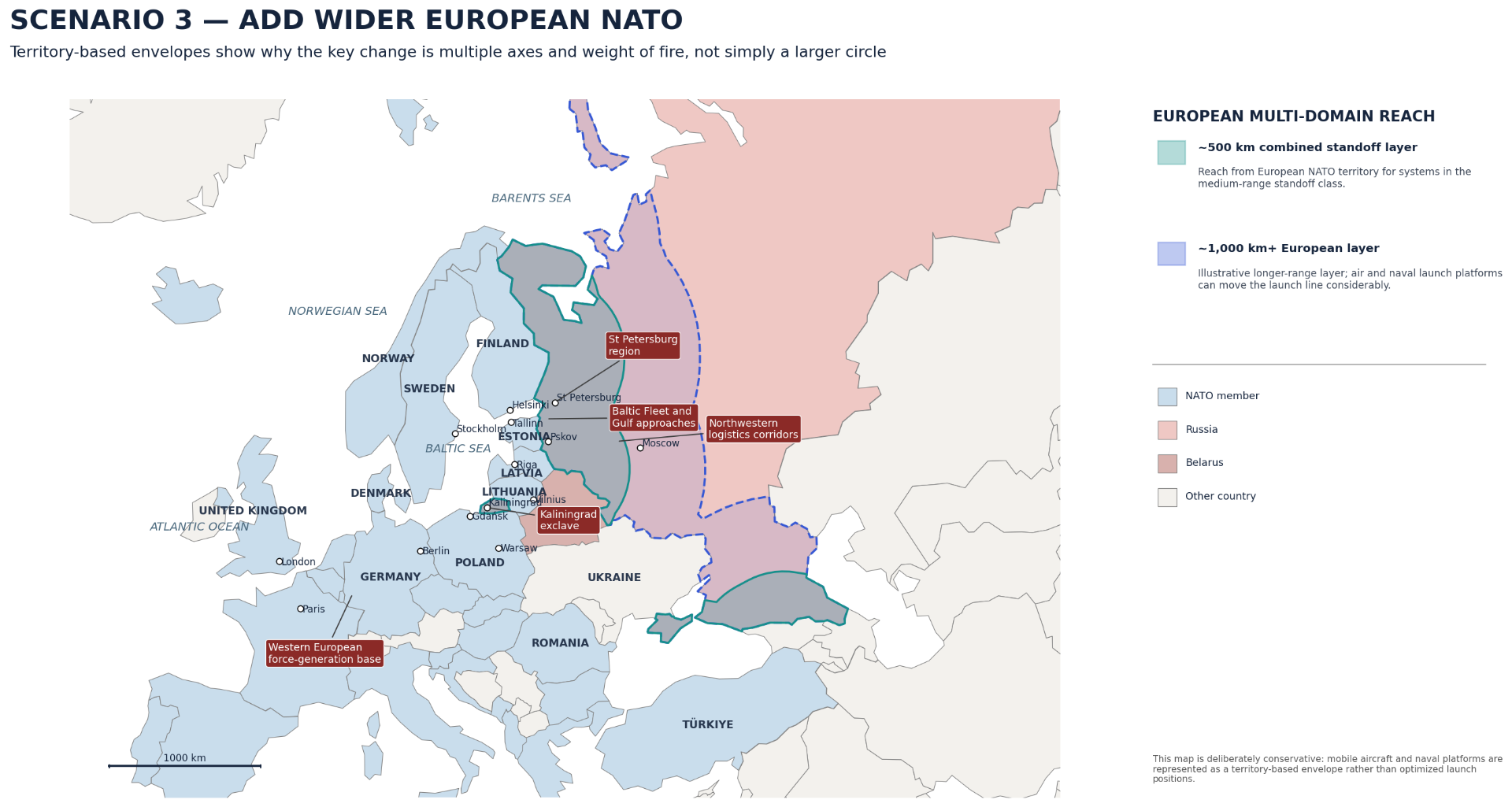
European NATO already possesses multiple families of long-range conventional weapons. Poland operates JASSM and is expanding into JASSM-ER, which the Polish defence ministry describes as having a range of around 1,000 kilometres, with the current acquisition delivered over 2026–30.[8] Britain, France and Italy operate the Storm Shadow/SCALP family.[9] Germany possesses Taurus, whose manufacturer gives a range above 500 kilometres.[10] Britain also possesses submarine-launched Tomahawk,[11] while France operates naval cruise missiles. Finland’s transition to F-35 will eventually add another JASSM-ER platform to the northern part of this architecture, while its Hornet/JASSM force already belongs in the 2026 baseline.
A European coalition therefore does not merely add another ring to the map. It adds different launch domains. Ground systems can operate across the Nordic-Baltic and Polish theatre. Aircraft can move their release points. Naval platforms introduce additional axes. Larger European militaries also bring more platforms, ISR, electronic warfare, logistics, and—depending on actual stockpiles and political decisions—greater potential magazine depth.
The Russian defence problem would therefore extend beyond the forces physically fighting at the frontier. Kaliningrad would remain geographically exposed. So would the wider system supporting operations against northeastern NATO: military aviation, long-range fires, air defence, command-and-control, repair and supply activity, rail military logistics and maritime forces throughout western Russia.
This does not mean that every system can reach every point, or that European stocks are sufficient for an indefinitely sustained campaign. The meaningful variables are range multiplied by available inventory, platform survivability, ISR, penetration, production and sustainment.
Figure 4
Scenario 3 — Wider European NATO
 Illustrative / not operational
04
What “putting Russia at risk” actually means
The relevant object is not Russia’s total land area. It is the military capability required to conduct and sustain a particular war. A country may have immense territory beyond an opponent’s practical reach while the military effort in one theatre remains dependent on capabilities much closer to the fighting.
Potential exposure matters in several ways. It can make assembling and sustaining forces more demanding. It can divert resources toward protection of rear areas. It can interrupt particular military functions or force them to operate farther away. It can also complicate any attempt to keep a conflict geographically confined.
A range envelope establishes a geographical possibility, not a military result. There must still be reliable intelligence, an appropriate weapon, an available platform, political authorization, successful delivery and an assessment of effect. Repeated operations require replacement ammunition and surviving launch systems. Russia would be trying to destroy those systems in return.
And a conventional scenario does not guarantee that escalation remains conventional. Deeper conventional reach can strengthen deterrence precisely because it complicates an aggressor’s assumption that a war can remain geographically bounded; it can also increase the consequences of miscalculation.
05 / Conclusion
The map cuts both ways
None of this makes the Baltic states geographically large. It does not make Russia small. And it certainly does not make a NATO–Russia war attractive.
The familiar Baltic war scenario rests heavily on geography: short distances, small NATO countries and the possibility that Russia could create a military fact before the Alliance reacted. But distance works in both directions. Finland’s accession extended NATO’s frontier deep into the Russian northwest. Sweden’s accession altered the military geography of the Baltic Sea. Baltic acquisitions are adding increasingly capable precision fires. Ukraine has demonstrated technologies capable of reaching much farther and is already establishing production and technology-transfer partnerships around the region. Europe possesses another layer of conventional strike behind them.
Deterrence does not require convincing Russia that NATO intends to attack Russia. It requires convincing Russian decision-makers that they cannot start a conventional war while confidently defining where that war will remain geographically contained.
A limited attack on Estonia would not necessarily produce a conflict limited to Estonia. An attack on Finland would not imply that the Russian side of the frontier remained untouched. A Russian force operating from Kaliningrad could not assume Kaliningrad was simultaneously an offensive platform and a protected sanctuary.
The Baltic states’ lack of strategic depth remains real. But the changing arsenal of northern Europe creates a different form of depth: the ability to push the military problem back across the frontier.
The strategic map has not changed shape. What has changed is how far the effects can travel across it.